License to Trim
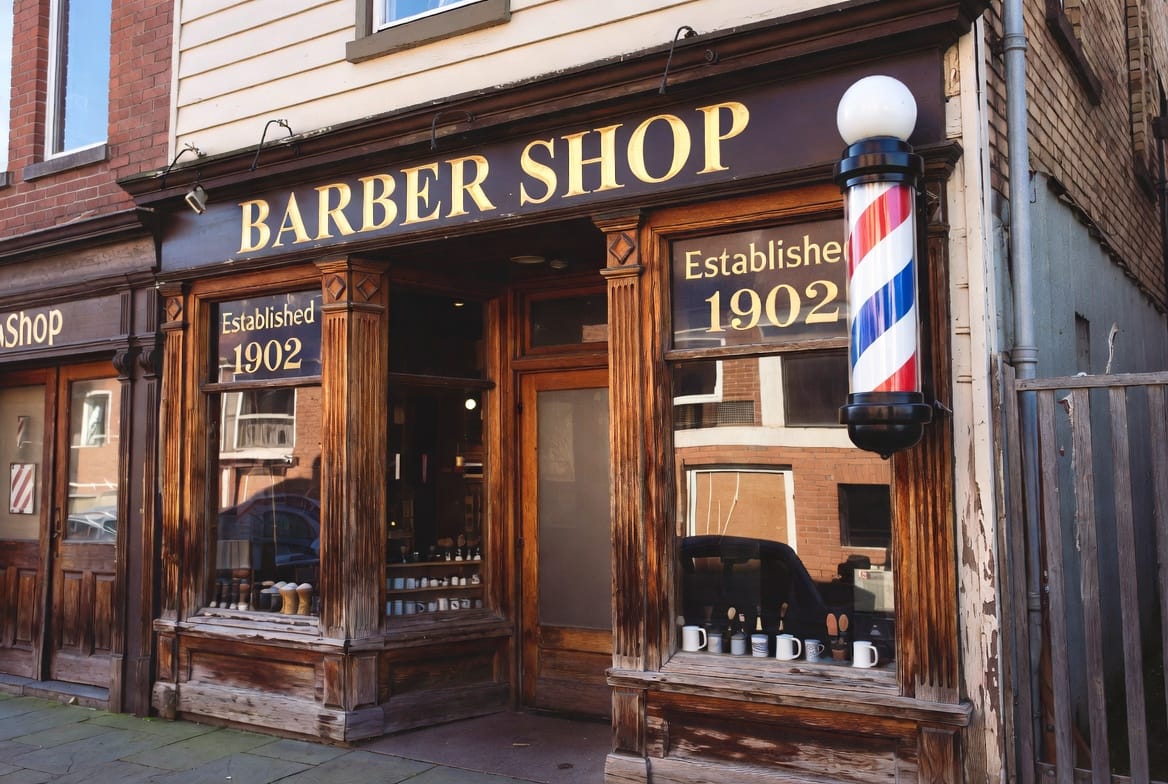
I had a chance conversation with a guy who has spent forty-something years working as a barber. I’ve always thought it baffling that hair cutting is licensed by the state. I’d really like to know the history of this gross over reach. There was once a time when you could just cut someone’s hair. At some point that started changing, gradually, I’m sure, with people giving a nod of consent to each small encroachment because it was framed as the common good. “You surely don’t want a repeat of that one hair cutting tragedy!” The only thing surprising about the current state of our [over]-regulation is that there aren‘t federal laws and regulations by which states must abide. At least I’m assuming the feds aren’t (yet?) in on this.
Anyway, back to barber: “licensing is important — you don’t want just anyone cutting your hair!” Yeah, I feel a ton better with the state giving credentials to my barber. I definitely haven't had any bad haircuts by licensed barbers, nooooo.
I had to look it up. The short version is that barbers, when left to their natural habits, are nasty. Some excerpts for your enjoyment:
This was soon followed by other states, with the profession’s close physical contact and use of sharp tools raising fears of disease transmission, such as “barber’s itch” (a bacterial skin infection like impetigo).
But the far more believable explanation is just simple gate keeping:
Economic factors played a significant role, as native-born barbers sought to restrict entry into the field amid rising competition from immigrants in urban areas.
And the entirety of the Grok history on barber licensing:
The history of state licensing for hair cutting in the United States primarily revolves around the regulation of barbers and cosmetologists, as both professions involve hair cutting (though barbers traditionally focused more on men’s grooming, while cosmetologists handle a broader range of beauty services including hair styling and chemical treatments). Licensing emerged as part of a broader wave of occupational regulations in the late 19th and early 20th centuries, driven by a mix of public health concerns and economic motivations to limit competition. Below is an overview of its origins, key developments, and evolution.
Origins and Early Adoption for Barbers
Barbering was one of the earliest personal service occupations to face state-level licensing in the U.S., with regulations beginning in the late 1800s. Minnesota became the first state to enact a barber licensing law in 1897, requiring examinations, registration, and often extensive apprenticeships or training to ensure practitioners met basic standards of hygiene and skill. This was soon followed by other states, with the profession’s close physical contact and use of sharp tools raising fears of disease transmission, such as “barber’s itch” (a bacterial skin infection like impetigo). Early requirements were stringent: some states mandated up to three years (around 6,000 hours) of training or apprenticeship, often at newly established barber schools like the first one founded in Chicago in 1893.
The push for licensing wasn’t solely about public safety. Economic factors played a significant role, as native-born barbers sought to restrict entry into the field amid rising competition from immigrants in urban areas. Professional associations, such as the Associated Master Barbers of America (formed in 1924), lobbied for these laws to protect incumbents’ livelihoods. By the early 1900s, licensing spread rapidly, with states like California, New York, and Texas adopting similar measures as urban populations grew and policy innovations diffused geographically.
Expansion to Cosmetology
Licensing for cosmetologists (often called beauticians early on) lagged behind barbers, emerging in the 1920s as women’s beauty services professionalized amid cultural shifts like the flapper era and rising demand for hair styling. Illinois passed one of the earliest laws with the Beauty Culture Act of 1925, which outlined requirements for examinations, fees, renewals, and reciprocity between states. Initial standards were less demanding than for barbers, typically requiring fewer training hours, as cosmetology was seen as posing lower health risks at the time.
Similar to barbering, cosmetology licensing was influenced by public health goals (e.g., safe use of chemicals and tools) and economic protectionism, with professional groups advocating for barriers to entry. Pioneers like Martha Matilda Harper, who created the first salon franchise system in the U.S. starting in the late 1800s, helped formalize the industry, paving the way for regulated education in the 1930s.
Evolution and Convergence
Throughout the 1920s and 1930s, barber training requirements relaxed significantly in many states—dropping to around 1,000 hours—as later-adopting states set lower bars and practical challenges arose with overly long apprenticeships. By the 1950s, standards for barbers and cosmetologists began to converge, stabilizing at about 1,500 hours of training nationwide by the 1980s, influenced by national averages and lobbying from associations. Political factors also shaped this: more liberal states were less likely to increase hours post-1960, while unified Democratic governments accelerated adoption compared to Republican ones.
Licensing became universal across all 50 states by the mid-20th century, with variations in specifics like required hours, exams, and reciprocity. Today, every state mandates licenses for both professions, often overseen by dedicated boards, though debates persist over whether such regulations truly enhance safety or mainly serve as barriers to entry (e.g., studies show they can reduce the supply of barbershops and raise prices). Some reforms in recent decades have aimed to reduce burdens, but the framework established over a century ago remains largely intact.
Anyway, the whole thing is just dumb. If you don't like the way the barber cuts your hair (licensed or not), you go to another barber. This isn't a monopoly situation. You have choices. And – shocking as this may sound – it is rare that I find a barber whose work I really appreciate vs just being adequately pleased. And they're all licensed.
It sounds like the history of this just needed two things. (1) Some public service announcements telling the public, "make sure your barber uses <some sanitizing product>. your hair health depends on it!" and admonition to the incumbent players that competition is good. Adapt or die. The government should have more important things to do than protect barbers from immigrant labor.
Alright.