Product Review: TP-Link TL-SX1008 (10Gbps, 8-port network switch)
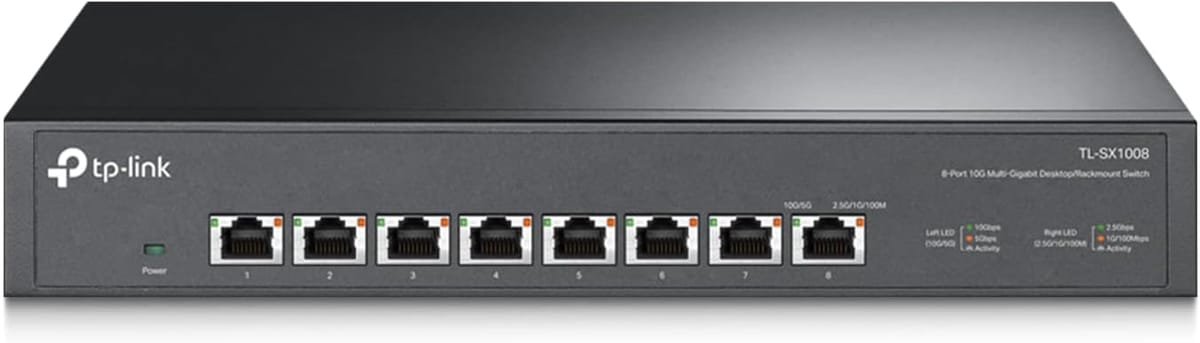
First, about price.
I had been watching this product on Amazon and B&H for some time (months, actually). At $280, I didn't quite feel I could justify it. I was right on the verge though when suddenly the price jumped to like $350 and just stayed there (ugh!). Inflation, maybe? Finally, as Black Friday approached, they had a "sale" (I guess they plan these things months in advance?), the price returned back to $280 (what a great deal!) and I (like a sucker) made the purchase.
Next, about noise.
Years ago, I was working on a budget and I wanted to connect a bunch of servers with 4x bonded 10Gbps ethernet connections. For almost no money at all, you can buy these out-of-warranty, unsupported, retired data center switches that will do nearly anything. You'll spend a ton of time on the command line trying to figure out how to configure them. Also, you'll go deaf. I started wearing ear pro in my office until I rigged up some sound-dampening curtains around my server rack – and even that wasn't adequate. Desperate, I finally retired them in favor of a used, prosumer-grade Netgear managed 10Gbps switch. It's still noisy (single-speed fan), but in contrast, it was sooo much quieter.
However, in my current office the loudest noise (if kids aren't playing with dominos) is the gentle humming of a hard drive. This Netgear switch would have raised the noise floor significantly. I was content to just stick with 1Gbps networking.
I read reviews on the TP-Link about noise and I also noted that it had a variable-speed fan. I was briefly concerned when I first plugged it in. The fan sped up all the way, but after a moment, it ramped down to an "idle" speed, which was fine. It is still noticeably louder than the background noise from hard drives, and I don't love the noise level, but it is vastly quieter than the Netgear and the noise is entirely tolerable.
If I could one day put a rack of equipment in a closet with adequate ventilation, I would 100% do that. I don't realize how noisy my office becomes until a day comes when I have to turn off everything (for whatever reason) and I get a reminder of what "quiet" actually is.
And, about why.
A shocking number of devices with built-in ethernet are stuck on 100Mbps. I remember back when gaming stores in the mall (yeah, that was a thing) upgraded to 1Gbps (literally decades ago), and we've basically been stalled there ever since. If you buy a new PC, it'll have a 1Gbps ethernet port. Your $500 fancy wifi access point that can do multi-gig transfers, has a 1Gbps uplink port. Your $500 gaming rig? Probably 1Gbps. Your internet service supports 2Gbps downstream (and probably 5Mbps upstream), but each port on your router is limited to 1Gbps. So, while I'd love to just use 10Gbps ports for everything, it is clearly not necessary (yet...). That would also be incredibly pricey.
In a more localized setting, it can make sense though. A NAS with a multi-gig ethernet port is not super common, but if you're piecing together a NAS, a 10Gbe NIC (like the Intel X550-T1) runs well under $100. If you have an open PCIe 3.0 slot on the motherboard, you're good to go. A typical spinning disk is good for ~100MB/sec in contiguous reading, which is 800Mbit, so multiply that by the number of HDDs in your NAS (depending on your RAID configuration), and you have a rough idea of the maximum possible network throughput. Modern desktop Macs have a 10Gbps upgrade for $100 (last I checked). Thunderbolt-equipped Macs can work with multi-gig ethernet adapters. So, if you've got a couple computers or accessories that support greater-than-1Gbps speeds, this is a relatively affordable way to maybe 10x your transfer speed (depending on the specifics).
Finally, about performance.
Having a 10Gbps switch is all well and good, but you need to be able to connect to it. I've got these little 1ft ethernet cables, and I've got a 50ft ethernet cable. So, back to Amazon I went. I decided to try out these braided cables. They claim to be "Cat 8", which is interesting. I don't know the cost of ethernet switches that support speeds limited to Cat 8, but I guarantee they're outside my price range. The websites probably just say, "call to schedule a demo with our sales department."
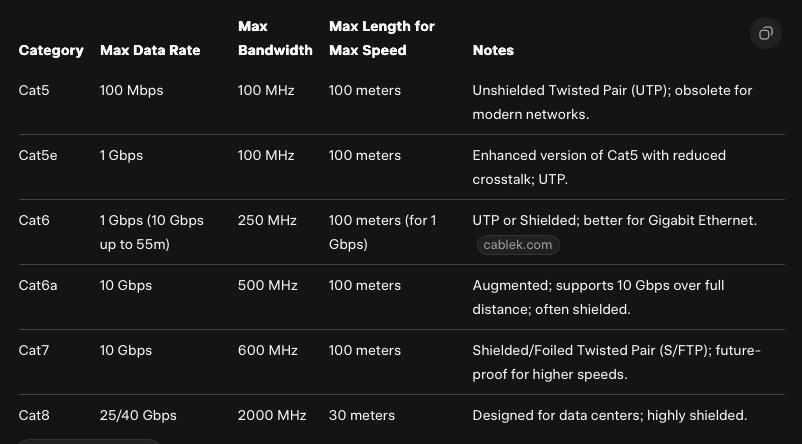
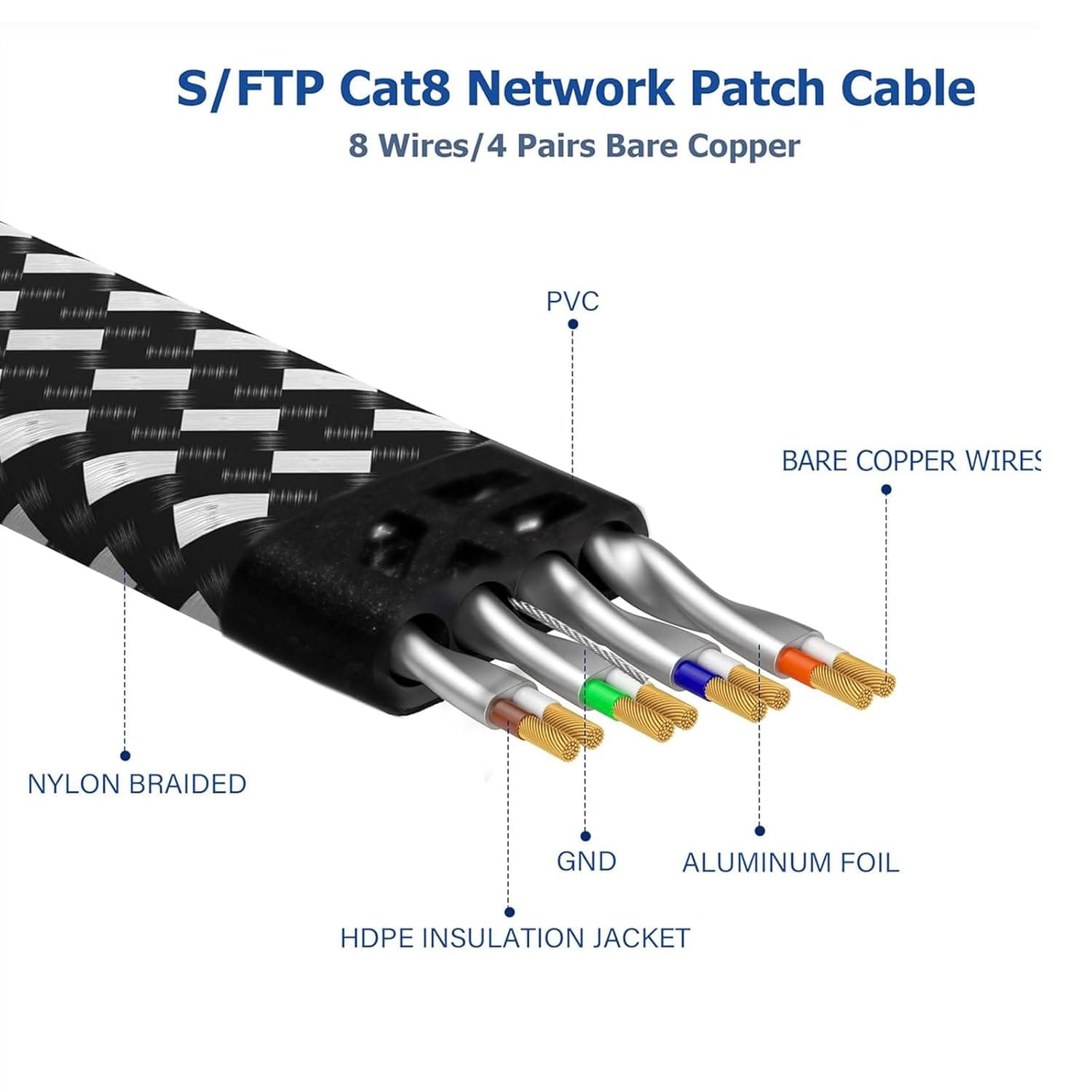
Is this what "highly shielded" refers to? Or is this company just abusing the "Cat 8" name for marketing purposes? According to my quick search, "S/FTP" is not related to secure protocols for file transfer, but rather "shielded / foiled twisted pair". At least the diagram seems legit. I'm probably not going to cut open the new cables to verify anything.
I'm not sure if the increased network speed will meaningfully benefit me until I make an investment in an upgraded NAS (which is a very low priority), but in doing a pointless PC-to-PC file transfer, I saw a sustained transfer speed of 1.1GB/sec (vs 119MB/sec before). So, yeah, 10x improvement.
Point is though, the cables work and the switch works, and my network speed is no longer the bottleneck for many-a-thing. And my cables are ready for that 40Gbps upgrade for whenever those switches become affordable!