The Fruit of the Vine or The Cup of Devils?
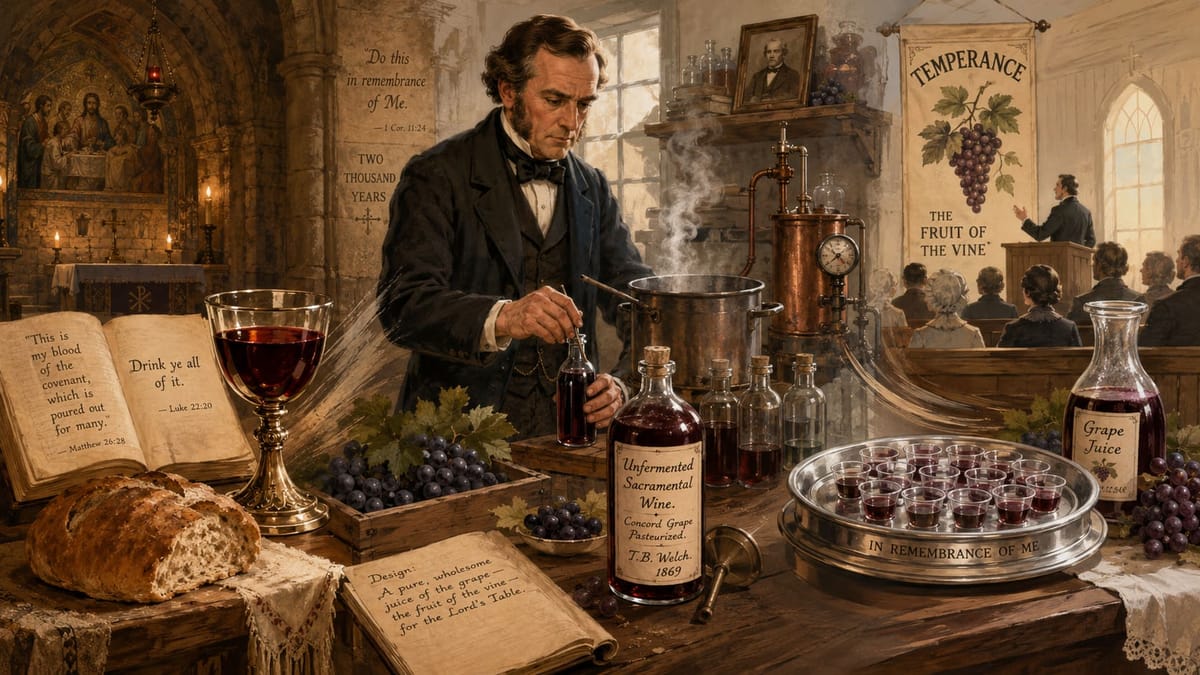
In the realm of protestantism, reformed churches are predominantly "wine" churches (relatively speaking) when it comes to Holy Communion, very much in contrast to basically every Baptist and non-denominational church. There are exceptions, of course, on both sides.
Would a reformed baptist church use wine or grape juice? Hmm.
If you ask a dyed-in-the-wool Baptist about communion, you'll likely hear that it has always been grape juice; that the "wine" of Christ's time was not nearly as alcoholic. Of course, ignoring all manner of history texts, we can just turn to the Bible where the Christians in Corinth were admonished about their drunkenness during communion:
When you come together, it is not the Lord’s supper that you eat. For in eating, each one goes ahead with his own meal. One goes hungry, another gets drunk. What! Do you not have houses to eat and drink in? Or do you despise the church of God and humiliate those who have nothing? What shall I say to you? Shall I commend you in this? No, I will not.
(1 Corinthians 11:20-22)
Maybe they were drunk in a sugar-high sense of the word, like when you feed kids too much fruit juice? However, I don't think that's what the admonishment was about. So, since the church from Christ's time has been using wine, when did grape juice actually enter the picture? Very recently, actually.
Thomas Bramwell Welch
Thomas Bramwell Welch, a British-born American, was the key figure. He immigrated to the United States as a child, became a Wesleyan Methodist minister (ordained in 1843), and later trained as a physician and dentist. A strong abolitionist and prohibitionist, he opposed alcohol entirely—he reportedly refused even to touch containers holding wine. This makes me wonder how he even participated in communion up to that point. Maybe he didn't? Also, for someone so strongly opinionated on government regulation, you'd think he would have been happier back in Britain.
In 1865, Welch moved to Vineland, New Jersey (a planned temperance town), and joined the local Methodist Episcopal Church as communion steward – whatever that is. At the time, many Protestant churches, especially Methodists, were grappling with the temperance movement amid widespread concerns over alcoholism. While the Lord's Supper had traditionally used fermented wine, raw grape juice fermented quickly at room temperature (home refrigeration was not yet common). Churches sometimes squeezed fresh grapes on the spot, used homemade substitutes, or continued with wine despite the tension with abstinence principles.
In 1864, the Methodist Episcopal Church had already recommended “the pure juice of the grape” for communion. Welch took this further. Of course.
In 1869, Welch applied Louis Pasteur’s recent pasteurization techniques to grape juice. Working in his kitchen with Concord grapes from the trellis outside his home, he heated and filtered the juice, then bottled it in a way that killed yeasts and prevented fermentation thereby creating a stable, non-alcoholic product he called “Dr. Welch’s Unfermented Wine” (or “Unfermented Sacramental Wine”).
He produced and sold it initially to churches seeking an alcohol-free option for Holy Communion. The goal was explicitly religious and temperance-driven: to offer churches “the fruit of the vine” instead of what he called “the cup of devils.”
The business did not immediately succeed on a large scale. Welch eventually stepped back from active production after a few years.
Charles E. Welch
Welch’s son, Charles E. Welch (also a dentist), revived and scaled the enterprise in the 1870s–1890s. Charles proved to be the better marketer. He promoted the juice heavily to churches through temperance publications, offered free samples, and advertised it as suitable for both communion and everyday use.
Key milestones:
- By the 1890s, Methodist conferences were advertising Welch’s grape juice in their journals.
- In 1893 (or 1897 per some records), the Welch Grape Juice Company was formally incorporated.
- Popularity surged at the 1893 Chicago World’s Fair, where samples were distributed widely.
- The temperance movement (including the Woman’s Christian Temperance Union) and later Prohibition boosted demand. In 1916, the Methodist Episcopal Church made the use of unfermented grape juice in communion effectively mandatory.
This is the kicker. Charles Welch later reflected on the origins in his will:
“Unfermented grape juice was born in 1869 out of a passion to serve God by helping [God’s] Church to give its communion ‘the fruit of the vine,’ instead of the ‘cup of devils.’”
Cup of Devils
What's our takeaway here? Thomas Welch's inability to market and sell or otherwise succeed with "pure" grape juice indicates that churches at that time did not use "regular" grape juice; they weren't particularly interested. Whether it was wine, or grape juice that had fermented, alcohol was involved; this was normal and expected. Ironically, in contrast to the Baptist position about the limited alcohol content of wine in Christ's time, it is seems true that for Methodists, their fermented grape juice had lesser alcohol content.
So, you have two thousand years of church history during which wine (actual wine) was used for Holy Communion, derailed by the Welches, to the extent that many Christians liken wine with communion as sinful, which is a shocking stance to take given Christ's overt use of wine.